
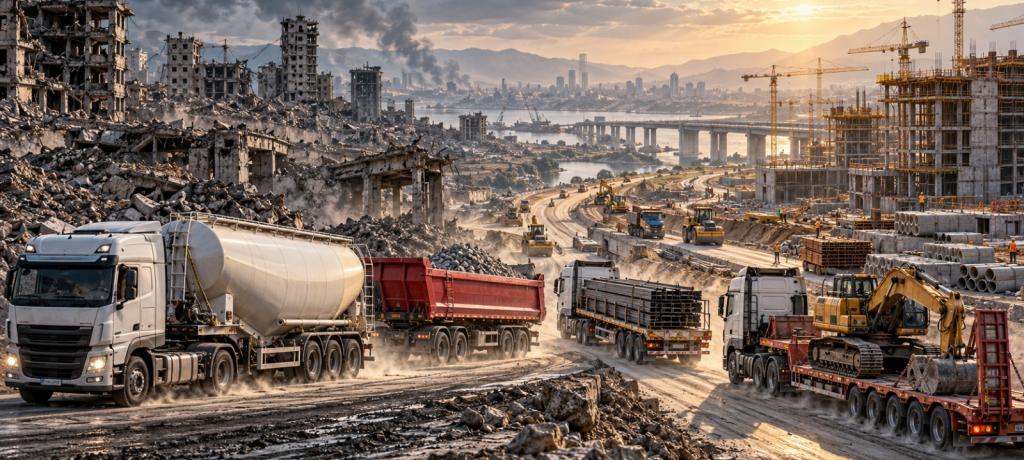
Wars, Reconstruction and
the Future of the Trailer Industry
A Türkiye-Centered Industry and Strategic Assessment
18 October 2026
Executive Summary
Conflicts in Ukraine, the Middle East and surrounding areas can disrupt border crossings, insurance and fuel costs, financing and vehicle investment in the short term. By contrast, safe and funded reconstruction can generate sustained freight demand for cement, aggregates, steel, precast components and heavy machinery, potentially benefiting specialized semi-trailers.
Key distinction: The scale of destruction alone does not translate into orders. Actual market potential depends on projects tendered and funded, security conditions, material flows and the capacity of existing fleets.
1. Scale of Reconstruction Needs
Assessments published by international institutions point to substantial economic needs. These figures are not estimates of the trailer market or direct spending on building materials; they cover various aspects of economic and social recovery.
|
Region |
Estimated need |
Assessment |
|---|---|---|
|
Ukraine |
US$588 billion |
World Bank and partners, February 2026; approximately ten-year need |
|
Gaza |
US$71.4 billion |
UN assessment, April 2026; approximately ten-year need |
|
Syria |
US$216 billion |
World Bank, October 2025; physical reconstruction cost |
The arithmetic sum of these three estimates is approximately US$875 billion. However, their methodologies and coverage differ, so this should not be interpreted as a confirmed combined investment budget.
In Ukraine, rebuilding roads, bridges, homes, energy systems and industrial infrastructure may stimulate transport. In Gaza and Syria, debris removal, essential infrastructure, housing and public buildings could generate substantial logistics needs.
2. How Construction Activity Creates Trailer Demand
Reconstruction occurs in stages, and the type of trailer required varies according to the project phase.
|
Reconstruction phase |
Key freight |
Suitable equipment |
|---|---|---|
|
Debris removal and earthworks |
Rubble, soil, demolition material |
Tipper semi-trailer / heavy-duty carrier |
|
Roads and infrastructure |
Aggregates, pipes, construction machinery |
Tipper, lowbed, platform |
|
Concrete and steel supply |
Bulk cement, rebar, structural sections |
Silo tanker, flatbed / platform |
|
Housing and industrial projects |
Precast elements, machines, plant equipment |
Platform, extendable and specialized trailers |
Technical note: Ready-mix concrete is generally delivered over short distances by mixer trucks. Bulk cement tank semi-trailers primarily carry dry bulk cement from plants or terminals to concrete batching plants.
3. Opportunities by Trailer Type
Bulk cement tanker (silo semi-trailer) — Transports cement and other suitable powdered materials. Demand may rise as concrete batching plants come online and construction reaches sustained volumes.
Tipper semi-trailer — Essential for debris, demolition waste, earthworks, sand, gravel and crushed stone; particularly useful in the initial reconstruction phases.
Lowbed semi-trailer — Moves excavators, bulldozers, cranes and other heavy equipment between construction sites.
Platform / flatbed semi-trailer — Carries reinforcing steel, structural sections, pipes and prefabricated building components.
Extendable / specialized semi-trailer — Used for bridge girders, large power equipment and heavy industrial modules; volumes may be lower, but engineering value per unit can be higher.
4. Regional Outlook for Türkiye
|
Geography |
Potential |
Main opportunity / constraint |
|---|---|---|
|
Ukraine |
Very high |
Major infrastructure and housing needs; EU supply chains and security constraints. |
|
Syria |
Very high |
Proximity and road links; security and funding uncertainty. |
|
Iraq |
High |
Construction, industrial investment and transit corridors. |
|
Iran |
Uncertain; potentially high |
Sanctions, banking, insurance and border security. |
|
Gaza / Palestine |
Very high rebuilding need |
Market-access restrictions; project logistics may dominate. |
|
Jordan |
Medium |
Regional logistics and transit links. |
|
Israel |
Uncertain |
Project pipeline and political/trade conditions. |
|
Russia |
Uncertain |
Sanctions, payment and route risks. |
These ratings are qualitative scenarios, not verified orders, sales figures or numerical demand forecasts.
5. Pressures on the Industry While Conflicts Continue
• Fuel, insurance, security and diversion costs may increase.
• Border delays and empty return trips may reduce the number of trips each vehicle can perform.
• Hauliers may postpone fleet investment amid uncertainty.
• Avoiding high-risk corridors may increase traffic along alternative routes.
• Emergency infrastructure repairs may require shipments of generators, mobile plants and heavy equipment.
Growth in international freight does not translate one-for-one into new semi-trailer purchases. Operators first increase utilization of their existing fleets; investments may accelerate only when a lasting capacity shortage emerges.
6. Product Priorities Across Reconstruction Phases
|
Trailer type |
Initial phase (0–2 years) |
Later phase (3–10 years) |
|---|---|---|
|
Tipper |
Very high |
High |
|
Bulk cement tanker |
High |
Very high |
|
Lowbed |
Very high |
High |
|
Platform / flatbed |
High |
Very high |
|
Specialized extendable |
Medium |
High |
|
Curtainsider |
Medium |
High |
The periods shown do not predict when any conflict will end; they are illustrative phases after safe reconstruction begins. Relative priorities are analytical judgments.
7. Business Models for Turkish Manufacturers
The opportunity extends beyond exports of complete trailers. Trailer chassis and body production, local assembly partnerships, designs tailored to regional conditions, rental, maintenance and spare parts may also generate demand.
According to industry figures published by TREDER, Türkiye’s trailer exports amounted to approximately US$777 million in 2023 and US$670 million in 2024. Exports for January–November 2025 were reported at about US$520 million, roughly 17% below the corresponding prior-year period.
Engineering firms specializing in manufacturing drawings and design services may find additional revenue opportunities in custom bodies, prototyping, weight optimization, production documentation and market-specific compliance.
8. Three Possible Industry Scenarios
A — Prolonged conflicts: Costs and financing risks remain elevated. Fleet renewals may be delayed, while emergency logistics continue.
B — Partial stabilization: Infrastructure projects begin in secure areas; regional demand for tippers, bulk cement tankers and lowbeds may increase.
C — Lasting security and comprehensive funding: Roads, housing, power infrastructure and industrial projects accelerate together; demand for vehicles, specialized equipment, maintenance and components may continue over several years.
9. Illustrative Bulk Cement Tanker Fleet Calculation
Assume that an additional 6 million tonnes of bulk cement must be transported by road each year in a given region. Take an average payload of 30 tonnes and 250 loaded trips per vehicle annually.
|
Calculation item |
Result |
|---|---|
|
Annual bulk cement volume |
6,000,000 tonnes |
|
Payload per loaded trip |
30 tonnes |
|
Annual loaded trips |
6,000,000 / 30 = 200,000 |
|
Loaded trips per vehicle annually |
250 |
|
Theoretical operational fleet |
200,000 / 250 = 800 silo tankers |
This does not mean 800 new trailers will be sold. Available capacity in existing fleets, trip distances, legal gross-weight limits, operating days, maintenance downtime and empty returns must also be considered.
10. Conclusions and Indicators to Monitor
For Türkiye’s trailer industry, the principal opportunity is not the temporary logistics pressure created by war but the sustained movement of freight generated by safe, funded reconstruction. Bulk cement tankers, tippers, lowbeds and flatbeds are promising segments. Market entry decisions should be supported by concrete project and fleet data.
Indicators to monitor regularly: tender and funding announcements; regional cement production and consumption; bulk cement transport volumes; existing silo-tanker fleets and utilization; road-border transit times; heavy machinery deployment; and trailer orders and fleet renewals.
Sources and Scope Notes
• World Bank and partners, Ukraine Rapid Damage and Needs Assessment (RDNA5), February 2026.
• United Nations, Gaza reconstruction and recovery assessments, April 2026.
• World Bank, Syria physical reconstruction cost assessment, October 2025.
• International Road Transport Union (IRU), regional logistics and trade corridor assessments, 2026.
• TREDER, Türkiye trailer industry export statistics (2023–2025).
This document is an informational industry analysis. Statistics refer to their stated publication periods; calculations rely on explicit assumptions. Regional demand rankings and growth scenarios reflect analytical judgment.