
The Black Swan Effect
The disruptions in maritime and air transport have hit overland trailer (tractor/semi-trailer) logistics—the very end-of-line of the supply chain—in an incredibly swift and severe manner. Throughout this process, both the operational structure and the cost dynamics of trailer transportation have fundamentally shifted, are shifting, and will continue to evolve.
The prominent logistics analyses and general market impacts regarding the current situation can be outlined as follows:
Fuel Shock and "Freight" Navigation
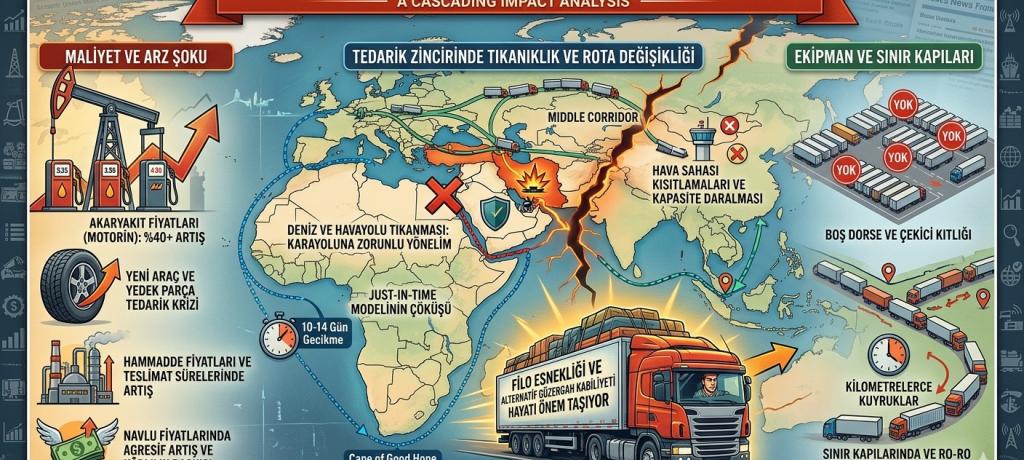
With the onset of the crisis, Brent crude oil prices surging past the $120 mark has driven global fuel (diesel) prices—the single largest input cost for road transport—skyward.
Cost Increases: Trailer companies are forced to directly reflect rising fuel costs onto freight rates (transport fees). This scenario has led to the aggressive implementation of "Bunker Adjustment Factor" (BAF) clauses into transport contracts.
Profitability Pressure: Small and medium-sized trailer enterprises that are unable to fully pass these costs down to their clients are facing severe cash flow and profitability crises.
Maritime Congestion and the "Mandatory" Rush to Ro-Ro / Road Transport
The closure of the Strait of Hormuz and the deactivation of the Suez Canal route (Red Sea) due to high security risks have forced vessels to circumnavigate the Cape of Good Hope (resulting in an additional 10–14 days of delay and massive container surcharges). Air cargo capacity has also contracted by 18% to 40% due to the closure of Middle Eastern airspace.
The Collapse of the "Just-in-Time" Model: To bypass these weeks-long delays in maritime and air transport, manufacturers and retailers are pivoting toward multimodal (Ro-Ro + Trailer) or direct overland transit routes.
Trailer Congestion on Asian-European and Regional Routes: Demand for trailers has peaked, particularly along the China-Europe (Middle Corridor) network and road corridors running through Turkey into Europe. High-value or time-sensitive goods (such as automotive components, fast-moving consumer goods, and chemicals) that cannot afford days of waiting at sea are being loaded directly onto trailers.
Equipment Shortages and Bottlenecks at Border Gates
The sudden shift of cargo demand to road transport has introduced a brand-new bottleneck to global logistics:
Empty Trailer Availability Crisis: Due to skewed import-export balances in specific regions (e.g., intra-Europe or Turkey-Europe transit lines), sourcing empty trailers and tractors has become increasingly difficult. Furthermore, congestion at container seaports is dragging down "hinterland" transport—the movement of cargo from ports to inland locations via trailers.
Queues at Border Crossings: The massive influx of freight onto alternative overland corridors (such as the Middle Corridor) is causing trailer queues to stretch for kilometers at border gates, customs checkpoints, and Ro-Ro ports, consequently extending overall delivery timelines.
Supply Industry and Rising Production Inputs
The economic shockwaves generated by the conflict are impacting more than just daily transport operations; they are directly affecting the manufacturing of the trailers themselves.
Raw Material Crisis: Due to the conflict, the market prices of industrial metals and raw materials—including aluminum, steel, and plastics—have climbed significantly.
New Vehicle and Spare Parts Scarcity: Faced with escalating raw material costs and fractured supply chains, trailer and tractor manufacturers are lengthening delivery lead times for new units or revising their pricing upward. This makes it difficult for transport firms to expand or modernize their fleets.
General Summary and Future Outlook
The current landscape demonstrates that "efficiency-oriented (Just-in-Time)" logistics frameworks are yielding to security- and inventory-focused "Just-in-Case" models. As maritime shipping loses its status as a safe harbor, overland trailer transportation is stepping up as a vital alternative. However, this shift is forcing the trailer sector to navigate one of the highest-cost, most congested, and highly unpredictable eras in its history. Because freight rates are highly unlikely to drop in the short term, operational flexibility and the capacity to utilize alternative routing remain absolutely vital in logistics management.