
The Arteries of Modern Economy: Movement, Oil, and the Fragility of Flow
The Arteries of Modern Economy: Movement, Oil, and the Fragility of Flow
Modern economy, though often described through complex financial systems, production networks, and digital infrastructures, ultimately rests upon a profoundly physical reality: movement. The continuous displacement of people, raw materials, and finished goods sustains the continuity of economic life. In this sense, airways, railways, and highways are not merely modes of transportation; they are the arteries of the global economy. What flows through these arteries is not just cargo, but the very continuity of production, the rhythm of trade, and the everyday life of societies.
At the heart of this circulation lies oil. Oil is the invisible yet indispensable carrier of modern economic life. From the operation of factories to the delivery of goods to consumers, every stage is directly or indirectly shaped by its presence. In this context, oil may be understood as the blood of the economic organism. Just as the flow of blood is vital to a living being, the uninterrupted flow of oil is equally critical for the global economy. Any disruption in this flow does not merely affect the energy sector; it triggers chain reactions that reverberate throughout the entire system.
Yet oil and infrastructure alone are not sufficient. The mechanism that activates and connects these elements is transportation. Transportation bridges the gap between production and consumption, binding the economic system into a coherent whole. Production and consumption rarely occur in the same place, and it is through transportation that this spatial divide is overcome. Thus, transportation is not simply a component of modern economy; it is a fundamental condition of its existence. Without it, production loses meaning and consumption becomes impossible.
Within this vast system, the trailer industry occupies a uniquely strategic position. Road transportation, with its flexibility, accessibility, and ubiquity, forms the backbone of the global logistics network. Trailers carry containers from ports into inland regions, facilitate the flow of intermediate goods between factories, and deliver products to the final point where they meet the consumer. While rail and maritime transport play crucial roles in high-volume logistics, it is the trailer industry that dominates the last mile and the critical interconnections. For this reason, the trailer sector is not merely a field of vehicle manufacturing, but a strategic pillar sustaining the continuity of global trade.
Contemporary geopolitical tensions and disruptions in energy supply have laid bare the fragility of this system. Any interruption in energy flow initially manifests as rising fuel prices, but soon escalates into increased transportation costs. These costs are transmitted into production, and ultimately reflected in consumer prices. What begins as a disturbance in the energy sector rapidly evolves into a systemic effect that spreads across the entire economic structure. Unlike traditional economic crises, this form of disruption is faster, broader, and deeply systemic.
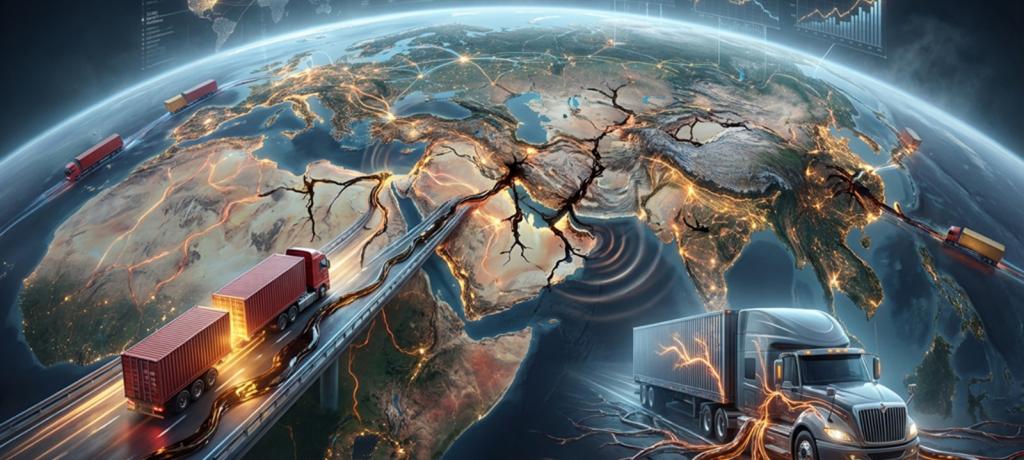
At this point, the concept of an “energy pandemic” emerges as a powerful metaphor. Just as a biological pandemic spreads rapidly and affects every layer of society, energy-based crises propagate through logistical and economic networks with similar intensity. The difference lies in the medium of transmission: not biological, but infrastructural and economic. A contraction in energy supply impacts transportation; rising transportation costs affect production; and increased production costs reshape consumption. In such a system, no sector remains isolated.
The trailer industry, in particular, stands at one of the most critical points of contact in this “energy pandemic.” It is both highly sensitive to fluctuations in energy costs and highly effective in transmitting those effects throughout the system. Rising fuel prices directly increase transportation costs, while also exerting pressure on maintenance, operations, and fleet management. This forces logistics companies to adjust pricing, and these increases ripple through every layer of the supply chain. As a result, the trailer sector becomes both one of the most affected and one of the most influential components in the spread of the crisis.
In conclusion, modern economy is far less abstract than it appears; it is, in fact, a deeply physical and inherently fragile system. The relationship between roads, oil, and transportation forms its very foundation. Any disruption within this triad produces far-reaching consequences that affect the entire economic organism. Recent developments have revealed the depth of this fragility and demonstrated that energy-based crises differ fundamentally from classical economic fluctuations. In this regard, the concept of an “energy pandemic” is not merely a metaphor, but a powerful analytical framework for understanding the new generation of global crises.