
From Freight Rates to Supply Chains: The Domino Effect of War on Logistics
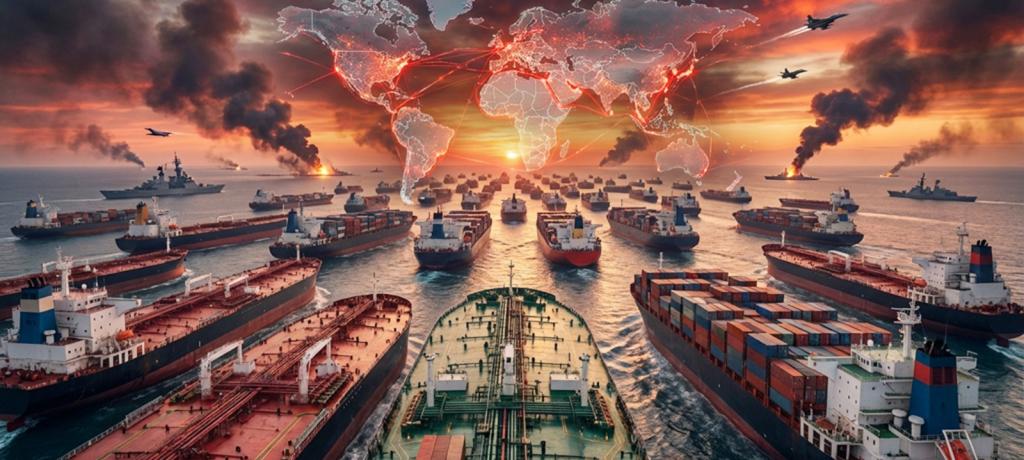
From Freight Rates to Supply Chains: The Domino Effect of War on Logistics
This conflict unfolding along the axis of Iran, Israel, and the United States goes far beyond a conventional regional war, evolving into a crisis that directly impacts the nerve endings of the global transportation system. The primary reason for this lies in the geographical reality that the conflict zone sits at the very center of the world’s most critical energy and logistics transit routes. In particular, the Strait of Hormuz, which connects the Persian Gulf to the Gulf of Oman and facilitates roughly one-fifth of global oil flows, functions not only as a military chokepoint but also as an economic bottleneck in such a scenario.
The first and most immediate impact of the war has been the uncertainty and security risks in maritime transportation. Oil tankers and container ships have either altered their routes or been forced to wait for safe passage due to the threat of attacks. This situation has not merely resulted in delays of a few days; considering the time sensitivity of global trade, even disruptions lasting a few weeks can trigger a cascading crisis. As of yesterday, countries such as India, Bangladesh, and several others in Asia have begun experiencing fuel shortages at petrol stations. Disruptions in oil and natural gas shipments have rapidly driven energy prices upward, and this increase has directly translated into higher transportation costs. Since fuel is the primary input of the logistics sector, any increase in fuel prices inevitably raises costs across land, sea, and air transportation.
At this stage, the transportation sector is facing not only cost pressure but also a severe routing crisis. The increasing risks in regions such as the Red Sea, the Suez Canal, and the Persian Gulf have forced ships to reroute around the southern tip of Africa. This does not merely extend distances; it also reduces fleet efficiency, slows container circulation, and effectively shrinks global capacity. The number of voyages a vessel can complete in a year declines, creating a market perception of “vessel scarcity.” As a result, freight rates surge rapidly, and these increases are ultimately passed on from producers to end consumers.
Another critical dimension is insurance and financial risk. From the very first days of the war, war risk premiums applied to operating vessels have increased dramatically. Following attacks on ships in the early stages of the conflict, insurance companies excluded certain routes from coverage altogether. This has led shipowners and logistics firms to avoid operating in these regions. Transportation is not merely a physical movement; it is also a financial system. As risk increases, the system’s appetite declines, and naturally, global trade slows down. Experts warn that the world could enter a recession, and if the conflict continues for several more months, economic growth may come to a near halt. This situation represents a serious breaking point, particularly for small and medium-sized logistics companies.
Although air transportation may initially appear to be an alternative, it quickly reaches its limits during crisis periods. Due to increased demand, air cargo prices rise sharply, making it a viable option only for high-value goods. This makes the transportation of low-margin or high-volume products significantly more difficult. In other words, no segment of the transportation system remains unaffected by such a crisis; each is impacted in different ways.
The most significant consequence of these developments is the disruption of supply chains. Modern production systems are built on the principle of “just-in-time” manufacturing, designed to minimize inventory costs. However, delays in transportation can escalate to the point of halting production lines. Cases where automotive manufacturers are forced to stop production due to the absence of a single component clearly demonstrate the fragility of this system. At this point, the transportation sector becomes not just a service provider, but a critical backbone that ensures the continuity of the global economy.
From Türkiye’s perspective, the situation presents a dual-sided picture. On one hand, rising fuel costs, increasing import prices, and overall economic uncertainty pose serious risks. The road transportation sector, in particular, which is heavily dependent on fuel, will be directly affected. On the other hand, Türkiye’s geographical position offers a significant advantage in times of such crises. As an alternative bridge between Europe and Asia, the importance of land and rail transportation increases. The route known as the Middle Corridor can emerge as a strong alternative to disrupted maritime routes. This creates the potential for Türkiye to evolve from a transit country into a strategic logistics hub.
My overall assessment is that such a war does not merely create a temporary disruption for the transportation sector, but rather triggers a structural transformation in the long term. Companies will shift toward shorter and more secure supply chains, regional trade blocs will strengthen, and logistics strategies will undergo permanent change. The priority will no longer be “the cheapest transportation,” but rather “the safest and most sustainable transportation.”
In conclusion, a war along the Iran–Israel–United States axis will make the transportation sector more expensive, slower, and more complex, while simultaneously creating new areas of opportunity. For companies that can survive this period and develop the right strategies, the crisis may also open the door to growth.